The Honored Archangel Michael
The Archangel Michael was with all the saints and martyrs. He strengthened them and enabled them
to endure patiently until they finished their strife. Festivals of commemoration are held and alms
offered in his name on the twelfth day of each Coptic month.
An example of one of his wonders: A God-fearing man whose name was Dorotheus and his wife
Theopista, held a festival of commemoration for the honored angel Michael on the twelfth day of
each month. It happened that this righteous family fell on hard times and had nothing to celebrate
with for the commemoration of the honored Michael. They took their clothes to sell so that they
might have a feast. Michael the Archangel appeared to Dorotheus and commanded him not to sell his
clothes, but to go to a sheep-master and to take from him a sheep worth one-third of a dinar. He
was also to go to a fisherman and to take from him a fish worth one-third of a dinar but Dorotheus
was not to slit open the fish until he came back to him. Finally, he was to go to a flour merchant
and to take from him as much flour as he needed.
Dorotheus did as the Angel commanded him. He invited the people, as was his custom, to the feast
honoring the Archangel Michael. When he went into his storeroom looking for wine for the offering,
he found that all the containers had been filled with wine and many other good things. He
marvelled and was astonished.
After they had finished the celebration and all the people had departed, the Archangel appeared to
Dorotheus as before and commanded him to cut open the belly of the fish. He found 300 dinars of
gold and three coins each is a third of a dinar. He told him these three coins were for the sheep,
the fish and the flour, and the 300 dinars were for him and his children. God had remembered them
and their oblations and had rewarded them here, in this world and in the kingdom of heaven on the
last day.
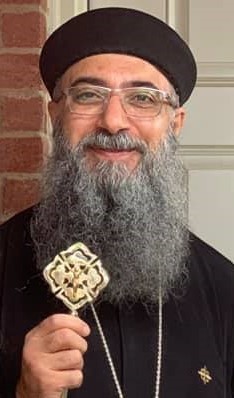
His Holiness Pope Tawadros II
His Holiness Pope Tawadros II is the 118th Pope of Alexandria and Patriarch of the See of St. Mark.
He was born in the name of “Wagih Subhi Baqi Sulyaman” on November 4th, 1952 in the
city of Mansoura, Egypt. His father was an Irrigation Engineer and his family moved around during
his childhood from Mansoura to Sohag and then to Damanhour.
His Holiness received his bachelor’s degree in pharmacy in 1975 from Alexandria University
and earned a fellowship for the World Health Organization from the British International Health
Institute in England in 1985. He attended the Coptic Seminary and graduated in 1983. He then worked
in a pharmaceutical company in Damanhour that was owned by the Ministry of Health.
His Holiness’s life has always revolved around church since his youth; he wished to live the
life of monasticism. He entered the Monastery of St. Pishoy in Wadi Elnatroun on August 20th, 1986
and remained a brother for two years. He was ordained a monk on July 31, 1988 and after a year he
was ordained a priest on December 23, 1989. Two months after, H.H. Pope Tawadros started serving
with H.E. Metropolitan Pakhomius of Beheira on February 15th, 1990. He was ordained a bishop on
June 15th, 1997 by H.H. the Late Pope Shenouda III as a General Bishop assisting H.E. Metropolitan
Pakhomius. His Holiness focused on childhood whether it was in the country-wide children’s
festival as well when he was in charge of the children’s committee in the Holy Synod. Before
assuming the papacy, H.H. wrote twelve books.
His Holiness was enthroned as the 118th Pope of Alexandria and Patriarch of the See of St. Mark on
November 18th, 2012 at the Coptic Orthodox Cathedral of St. Mark in Abbassiya, Cairo. The
enthronement was presided by H.E. Metropolitan Pakhomius of Beheira, the Patriarchal Locum Tenens,
other metropolitans and bishops of the Coptic Orthodox Church and was attended by many delegates of
other Christian denominations.
Preacher of The Christian Faith in Africa
St. Mark was a native of the North African county of Libya. He was born in the city of Cyrene in
Pentapolis, the western part of Libya, west of the border of Egypt. St. Mark was born of Jewish
parents three years after the birth of our Lord and Saviour, Jesus Christ. His original name was
John and his surname was Mark: “And when he (Peter) came to himself …, he (Peter) came
to the house of Mary the mother of John, whose surname was Mark, where many gathered together
praying” (Acts 12:11-12); and “Barnabas determined to take with them John, whose
surname was Mark” (Acts 15:37); “And Barnabas and Saul returned from Jerusalem, when
they had fulfilled their ministry, and took with them John, whose surname was Mark”
(Acts 12:25). St. Mark’s parents, Aristopolos his father and Mary his mother, migrated to
Palestine shortly after the birth of St. Mark because of the Berber attacks on their town and
property. They settled in Cana of Galilee not far from Jerusalem. A few years later St. Mark’s
father died and Peter Simon (St. Peter), who was married to a relative of St. Mark’s father,
took care of St. Mark and considered him a son: “The Church that is in Babylon, elected
together with you, salutes you and so does Marcus (Mark) my son” (1 Peter 5:13). Peter Simon
saw to it that St. Mark got a good education. St. Mark studied law and the classics.
Church Traditions state that Mary, St. Mark’s mother, was an admirer of Jesus Christ and
followed Him everywhere and that St. Mark was one of the attendants who served at the feast in
Cana of Galilee at which Jesus Christ turned the water into wine: “And the third day there
was a marriage in Cana of Galilee… and both Jesus and his disciples were called to the
marriage… when the ruler of the feast had tasted the water that was made wine, … This
was the first miracle Jesus did…” (John 2:1-11).